
Finding the average price point for each revenue generator is often harder than it seems. Most business owners get stuck on the outliers. You may have a few high-paying clients or a few lower-priced jobs, and those numbers can pull your attention in different directions. This makes it difficult to land on a number that actually represents your business.
The goal is not to focus on the extremes. The goal is to understand what your clients are typically paying, and if that number is enough to sustain your business income goals.
How to Calculate Your Average Price Point
To find the average price point for each revenue generator, you take the total income for that specific revenue generator and divide it by the number of clients associated with it.
For example, looking at the Essentials revenue generator, I took the total income for the year and divided it by the number of clients in that subscription. That calculation resulted in an average price point of $359 per client. And then it became obvious that we were not charging enough for the amount of time my team spends on average on bookkeeping for each client. So we raised our prices!
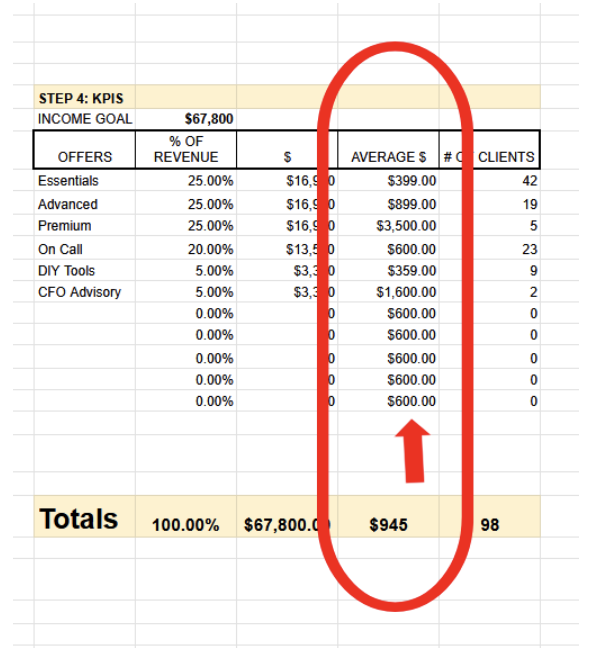
This same formula can be applied across your other revenue generators. For categories like Advanced and Premium, you follow the same process. If you have a revenue generator such as Add Ons that is based on a fixed hourly rate, that price point will remain consistent and does not require averaging in the same way.
Why the Average Matters
It can be tempting to use your base price when setting your goals. It can also be tempting to use your highest price, especially when you know what is possible.
Neither approach gives you an accurate picture.
When you use your base price, you are setting your expectations too low. When you use your highest price, you are setting expectations too high. In both cases, your projections become unreliable.
The average price point provides a realistic and grounded number. It allows your projections, your lead generation, and your conversion expectations to be more accurate. It gives you a number that reflects what is actually happening in your business, not what you hope will happen or what occasionally happens.
How Often Should You Review It
Your average price point should be reviewed every month.
Each month brings new data. New clients come in at different price points. Existing clients may upgrade, downgrade, or change their level of service. All of this impacts your true average.
When you review this KPI monthly, you are always working with the most current and accurate data. This keeps your forecasting aligned with reality and allows you to make adjustments as your business evolves.
Final Thoughts From Your Favorite Accountant
Your average price point is one of the most honest numbers in your business. It removes the emotion from pricing. It removes the attachment to your highest or lowest offers. It shows you what your clients are actually paying and what your business is consistently producing.
You might look at your average price point and realize it is lower than you expected. You might feel frustrated, discouraged, or even a little disappointed in yourself. That is a very normal reaction. It is showing you the truth of where you are today so you can make better decisions for where you want to go.
When you understand your average price point, your income goals become more accurate. Your sales expectations become more realistic. Your growth becomes more intentional. And you realize that by raising your prices, you are not gouging your customers. You are just making enough to run your business with cash reserves.
If you are ready to gain clarity in your revenue using The STOP Method™, here is how I can support you:
📊 Bookkeeping Services
💼 Self Guided Financial Masterclasses
📘 Buy my Budgeting Book
Because at the end of the day, cash flow isn’t luck, it’s strategy.