Broke even is a concept I teach inside The STOP Method™, and it is one of the most eye-opening numbers for business owners.
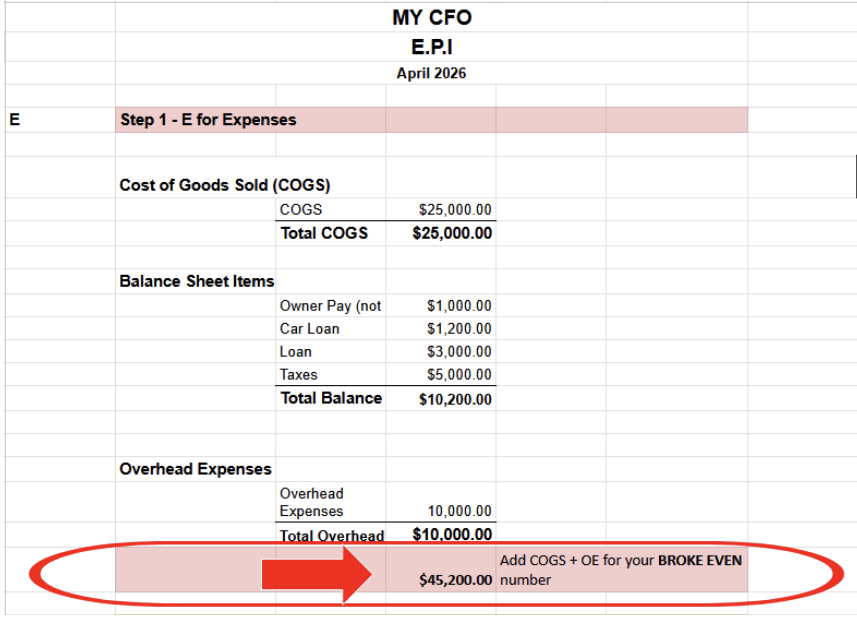
Your broke even number reflects the bare minimum required to keep your business open. It is the amount of revenue needed to cover your Cost of Goods Sold and your overhead expenses.
With the EPI formula (Expenses + Profit = Income), COGS and overhead expenses are added together to calculate the broke even number. You may be familiar with this as your “break even” point. To me, break even equals broke, which is why I call this number broke even.
If you are only achieving this number in your sales, this is why you have cash flow issues and why you will continue to feel broke. You will not be able to scale from this position.
Why “Break Even” Keeps You Broke
Traditional accounting uses the term “break even,” which sounds neutral. In reality, operating at this level is anything but neutral. Operating at broke even creates constant pressure.
When your revenue only covers your costs, there is no profit, no margin for error, and no room to grow. You are covering your expenses, but that is all. Broke even is the equivalent of living paycheck to paycheck.
You are barely getting by, and only the essentials are being taken care of. When you are operating at broke even, you will not be able to invest in opportunities that come your way. You will not be able to consistently transfer money into your four STOP bank accounts. Your broke even number has zero room for scaling or saving for the future.
How You End Up Operating at Broke Even
When you are blindsided by an expense or make purchases that were not planned for, cash flow becomes tight very quickly. This is when business owners begin to struggle with payroll or covering operating costs. In many cases, loans become the only option to stay afloat.
Many business owners set an arbitrary top-line revenue goal without understanding what that number needs to cover from a COGS and expense perspective. When that revenue does not account for the natural fluctuations in COGS and overhead, the business operates at broke even.
There is no room for error, no room for growth, and no room for profit. Hence, you are now “broke even”.
The Reality of the Numbers
Seeing your broke even number is often one of the most frustrating moments in business.
When you see how much it truly takes to operate your business, even without additional upgrades or extras, it can feel overwhelming. It forces you to confront the gap between what you thought your business needed and what it actually requires.
At the same time, it brings clarity. When you see your broke even number, you understand why your sales, even when they feel strong, are not covering your expenses. You understand why you are constantly playing catch up. You begin to see that the income coming in is simply matching your broke even number.
Why This Matters for Growth
If you continue to only achieve your broke even number, your business will require outside support to survive. This often looks like taking on loans or reinvesting personal funds just to keep operations going. Even at higher revenue levels, this does not automatically correct itself.
There are many seven plus figure business owners who are still operating at broke even. High revenue does not guarantee profitability or financial freedom. In many cases, owners are paying themselves modest salaries while carrying significant debt or personal investment in the business. Revenue alone does not create wealth. Margin does.
Final Thoughts From Your Favorite Accountant
Understanding your broke even number changes how you operate your business.
You begin to see the true cost of running your business, and you can build a financial foundation where your pricing, profit, and growth are supported by real numbers.
The goal is not to break even. The goal is to build beyond it.
If you are ready to get clear on your numbers and move past broke even, here is how I can support you:
📊 Bookkeeping Services
💼 Self Guided Financial Masterclasses
📘 Buy my Budgeting Book
Because at the end of the day, cash flow isn’t luck, it’s strategy