

Diversifying your revenue generators is what keeps your business in business.
We have already talked about how important it is not to put all of your eggs in one basket when it comes to the services or products you offer. We also talked about how amazing your cash flow is to offer too many services and products. There is another layer to this that is just as important.
You cannot have all of your income coming from one revenue generator. That might be one service, one product, one client, or one customer. When too much of your revenue is concentrated in one area, your business becomes at risk to fail should you lose the ability to sell that one revenue generator.
Why Diversification Matters
When a large percentage of your income comes from one revenue generator, you are exposed to unnecessary risk.
If 90 percent of your revenue comes from one service or product, what happens if that service is no longer in demand, or you decide to remove it, or something shifts in the market?
It would devastate your business. When your revenue is spread across multiple generators, your business becomes more stable. You are able to pivot more easily. You are able to adjust your marketing with intention. You are able to make decisions without feeling like everything is on the line. Diversification creates options, and options create stability.
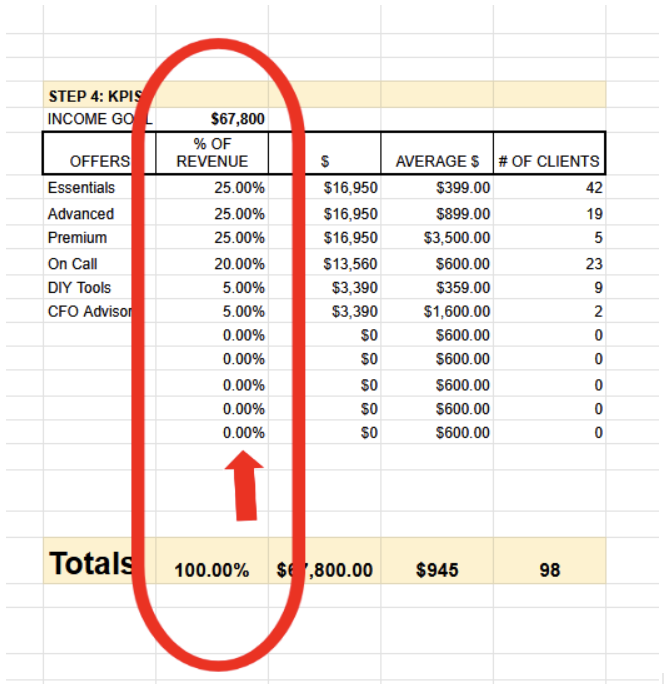
What This KPI Shows You
Tracking the percentage of revenue for each revenue generator shows you exactly where your money is coming from. It allows you to see whether your income is balanced or heavily weighted in one area. It also shows you where your opportunities for growth are.
This is not about making everything perfectly equal. It is about making sure your business is not dependent on one source.
How to Find Your Percentages
I use QuickBooks to calculate my percentages because it keeps all of my data in one place.
To pull this report in QuickBooks, follow these steps:
Step 1: Log into QuickBooks
Step 2: Click on Reports
Step 3: Click on Profit and Loss
Step 4: Select your date range. I recommend one year of data. If you do not have that, use three months.
Step 5: Select the option to compare a period
Step 6: Click the percentage of income box
Step 7: Run the report
Step 8: Review your data
This report will show you the percentage of income coming from each revenue generator.
If Your Revenue Is Not Categorized
If all of your income is still sitting in one “Sales” category, you need to sub-categorize it. This is not optional if you want clarity on the revenue generator levers you can quickly shift, should you need to.
If you do not know how to do this, hire a bookkeeper. This is an area where mistakes can create bigger issues in your finances. Once your revenue generators are set up properly, your bookkeeper can reallocate your income using journal entries so your data reflects reality.
Why Your Bookkeeping Matters
You might be tempted to rely on third-party systems or reports to track this information. While those tools can be helpful, they do not replace having accurate data inside your bookkeeping system.
QuickBooks (or other accounting software) allows you to see everything in one place. It supports your budgeting, forecasting, and KPI tracking without requiring you to pull multiple reports from different systems. The return on time investment of having your books set up correctly is significant.
Technically, you could track this manually in spreadsheets. But, realistically, when you are trying to scale and pulled in a million different directions, this is something you should systemize and automate within your accounting software.
You might manually enter the data once or twice, but over time, it becomes too time-consuming. Eventually, you will stop tracking it altogether.
You know this. I know this.
The goal is to build systems that are sustainable, not ones that rely on constant manual effort.
What Percentages Should Each Revenue Generator Aim For?
The goal is to have your revenue as evenly distributed as possible across your three to twelve revenue generators. This does not happen overnight, and it does not need to be perfect. What matters is that you start tracking it and are moving toward balance.
Most businesses are not balanced when they first look at this KPI. That is normal. The key here is to start by identifying your top 3 to 12 highest performing revenue generators. Then focus on the profit margins and how to diversify your clientele across the top 3 to 12 highest performing revenue generators.
This approach allows you to be intentional with your marketing. Instead of trying to grow everything at once, you focus your energy on one area. Over time, this creates diversification. When you choose one revenue generator to grow, your messaging becomes clearer. Your marketing becomes more targeted. Your audience becomes more defined.
Where focus goes, energy flows. As you continue to increase that one category, your business begins to stabilize because your revenue is no longer dependent on a single source.
Final Thoughts From Your Favorite Accountant
Diversification is about working smarter, not harder. I am trying to help you build a business that can withstand change. When your revenue is spread across multiple generators, you create stability, flexibility, and confidence in your business decisions.
You no longer feel like one shift could take everything down. You begin to trust that your business can adapt and grow. This KPI is not meant to overwhelm you. It is meant to show you where you are today and where you can grow next.
You do not have to fix everything at once. You just have to start paying attention to what you offer and how you offer it.
If you are ready to gain clarity in your revenue using The STOP Method™, here is how I can support you:
📊 Bookkeeping Services
💼 Self Guided Financial Masterclasses
📘 Buy my Budgeting Book
Because at the end of the day, cash flow isn’t luck, it’s strategy.