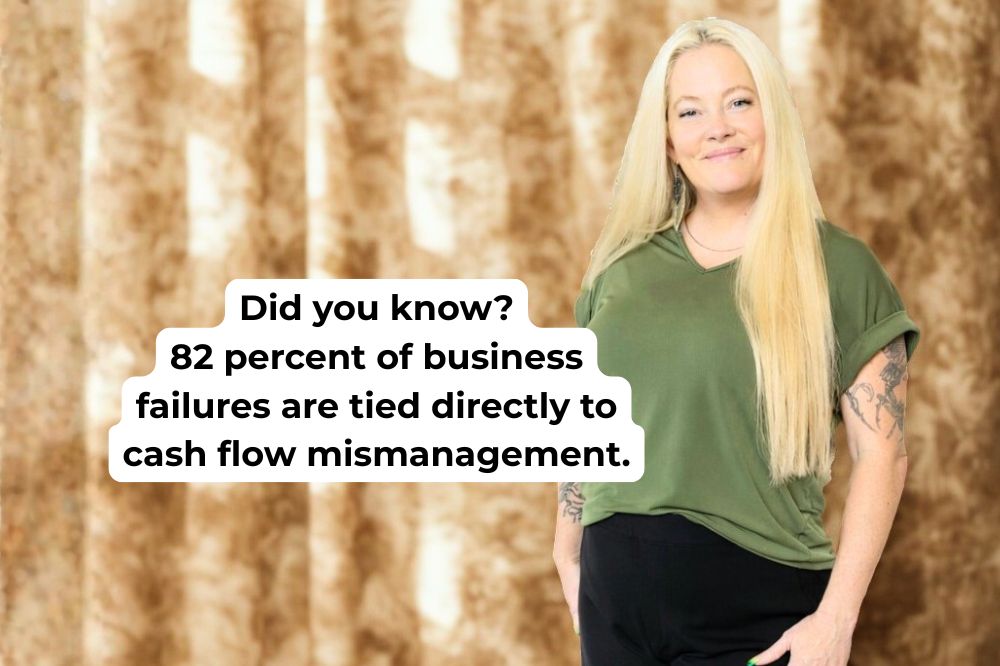
Some estimates suggest that as many as 50 percent of businesses fail within the first five years. Depending on your industry, that number can climb even higher. Even if we take the most optimistic interpretation, the math is sobering. You are essentially looking at a coin flip. There is a fifty-fifty chance your doors will still be open after five years. In addition to those statistics, U.S. Bank research found that 82 percent of business failures are tied directly to cash flow mismanagement.
And those statistics only measure businesses that completely shut down. They do not account for businesses that technically survive but operate under chronic stress and a break-even mentality. They do not measure owners who plateau their revenue, pay themselves inconsistently, and slowly lose the enthusiasm and passion that once fueled their vision. Survival is not the same as stability, and stability is not the same as growth.
The Psychological Cost of Staying Stuck
When your revenue fluctuates month to month, it creates more than financial strain. Inconsistent income activates uncertainty, and uncertainty activates stress and anxiety. Over time, that can turn into depression, overwhelm, and emotional exhaustion. The American Psychological Association consistently reports that money is the leading source of stress for adults in the United States. As a business owner, that pressure multiplies because you are not only responsible for yourself, but also for employees, vendors, and clients who depend on you.
When a business operates without predictable cash flow, it naturally falls into a cycle of reaction. Owners complain about slow months but do not adjust their pricing model or revenue generators. Market conditions are blamed but offers do not get restructured. Owners compare themselves to competitors but do not innovate. Over time, this reactive pattern becomes normal.
Psychologists call this learned helplessness. When we begin to feel like outcomes are outside our control, we stop attempting meaningful change, even when change is completely possible and within our control. In business, this looks like repeating the same sales strategy year after year while expecting different results. It looks like hoping the next quarter will fix what last quarter failed to accomplish, even though we are not doing anything differently.
Albert Einstein said, “We cannot solve our problems with the same thinking we used when we created them.” You may find yourself trying to fix inconsistent revenue with more hustle instead of changing your revenue strategy and offers.
Why So Many Businesses Plateau
Complaining about volatility without changing strategy guarantees stagnation. Many businesses plateau because revenue is tied entirely to one-time projects, seasonal spikes, or inconsistent sales cycles. Each month resets to zero. Each day depends on closing new deals. That constant reset keeps your nervous system in fight-or-flight mode.
When your income is unpredictable, you delay hiring, which limits your capacity to grow. You underinvest in systems, which keeps you working nights and weekends. You hesitate to raise prices because if clients are not buying now, they certainly will not if you increase your rates. You avoid delegating or mentoring because you tell yourself you can do it faster and cheaper. Over time, this creates a ceiling.
You stay stuck on the entrepreneur hamster wheel, burning yourself out while convincing yourself this is just what business ownership requires.
Without recurring revenue, growth requires constant acquisition. According to Harvard Business Review, acquiring a new customer can cost five to twenty-five times more than retaining an existing one.
Recurring Revenue Changes the Math
Recurring revenue changes everything because it introduces predictability. When you know that a percentage of your revenue will arrive each month because clients are on retainers, memberships, or monthly service agreements, your nervous system shifts. You begin focusing on innovation instead of survival. You start thinking about thought leadership, industry positioning, and long-term strategy instead of scrambling for the next invoice.
McKinsey & Company reports that subscription-based businesses grow revenues five to eight times faster than traditional models. They also command higher valuations because predictable revenue lowers perceived risk. Investors, lenders, and buyers value stability. But this is not just about valuation. It is about peace of mind.
Recurring revenue is not limited to a specific industry. It can exist in bookkeeping, consulting, fitness, education, legal services, trades, creative industries, and beyond. Every industry has the potential to create ongoing service models instead of purely transactional ones. The question is not whether it is possible. The question is whether you are willing to innovate and create one for your business.
Becoming a Thought Leader Instead of a Statistic
If half of businesses close within five years, being a business owner requires actively finding a way to succeed against that probability. That begins with asking yourself different questions. How can you create ongoing value instead of one-time delivery? How can you integrate your service into your clients’ regular rhythm? How can you become infrastructure rather than optional?
Peter Drucker said, “The best way to predict the future is to create it.” Thought leaders do not wait for industry shifts. They create new models within their industry. When you develop a subscription model, a retainer, a monthly advisory structure, or a recurring service plan, you are not simply adjusting pricing. You are stabilizing your future. You are reducing the likelihood that one slow quarter destabilizes everything you have built.
Recurring revenue increases lifetime value, improves retention, and strengthens forecasting. It also shifts your identity. Instead of being a service provider who closes deals, you become a strategic partner who builds ongoing transformation for your clients. That distinction keeps you from becoming a statistic.
Final Thoughts From Your Favorite Accountant
I say this with compassion because I have been there. Staying stuck and venting about working 16 hour days and not paying yourself feels validating. But it does not change your numbers. It does not change your margins. It does not change your future. Becoming a thought leader, creating a subscription for your business, and changing your revenue strategy does.
Designing recurring revenue into your business model reduces risk, stabilizes cash flow, and gives you breathing room to think beyond the next invoice. It gives you space to innovate, to lead, and to build something sustainable that allows you to beat the statistics. And to have fun while doing it! And what you might find, is that the care and support you get to provide to the clients on a subscription model is so much more amazing than your one and done revenue model.
If you are ready to move from reactive income to strategic stability, here is how I can support you:
📊 Daily Bookkeeping Services
💼 April CFO Advisory Workshop
📘 DIY Budgeting Tools
Because at the end of the day, cash flow isn’t luck, it’s strategy.