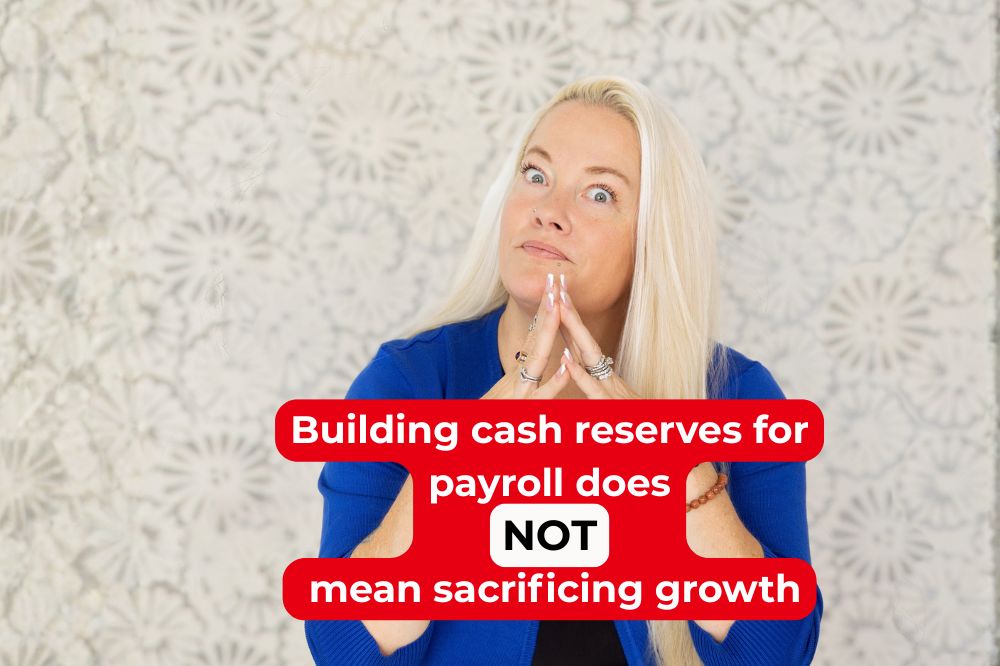
“If I put money into savings, I won’t have enough money left to grow.” This is one of the biggest objections I hear from business owners when we start talking about building cash reserves for hiring. Most business owners were taught that growth requires action and to reinvest everything. Savings, on the other hand, feels like a plateau and passive action. It can feel like money is sitting in a bank account doing nothing while opportunities are passing by. But that’s not what is happening.
What I find fascinating is that many business owners treat growth and savings as if they are competing priorities. They assume that every dollar transferred into savings is a dollar that cannot be used to grow the company. In reality, I have found the opposite to be true. The businesses that struggle the most with growth are often the businesses that never built the financial foundation of savings to support the ebbs and flows of cash flow.
Business owners are convinced that if there is only a few hundred dollars left over at the end of the month, there is no point in transferring it to savings because the amount feels too small to matter. The challenge with this mindset is that hiring is not the same as buying a piece of equipment or launching a marketing campaign. Most purchases are one-time decisions. Hiring creates an ongoing commitment that follows you for.ev.er (or for as long as you have employees). The moment someone joins your team, you are no longer responsible for a single transaction. You are responsible for their paycheck, their training, their development, and the financial stability they are expecting from your company.
Why Payroll Deserves Special Attention
There are very few expenses in a business that carry the same weight as payroll. If a software upgrade gets delayed, the business will survive. If purchasing a new vehicle or piece of equipment gets postponed, adjustments are made. If a marketing campaign gets pushed into next quarter, more adjustments are made.
But payroll is different because there are people attached to it, and so many rules, regulations, and laws associated with hiring employees. Plus, when employees accept a position with your company, they begin building their lives around the expectation that they will be paid consistently and on time. They make decisions about housing, transportation, childcare, and family obligations based on the commitment you made when you hired them.
Because of that, I believe payroll deserves a higher level of planning than almost any other expense inside a company. It should not depend on having a great sales month. It should not depend on collecting a large invoice. It should not depend on everything going perfectly. Payroll deserves its own layer of protection because the consequences of getting it wrong impact real people and can create lawsuits for the owners.
The Businesses That Hire Best Prepare First
One thing I have noticed over the years is that the healthiest hiring decisions rarely happen during emergencies or seasons of exponential growth. They happen when business owners have taken the time to prepare.
When hiring is done from a place of panic, owners are often looking for immediate relief. They are overwhelmed, overworked, and desperate for help. The employee becomes the solution to a problem that already exists. That creates pressure on everyone involved because the business is asking the employee to solve challenges from day one.
Hiring from a position of preparation is completely different. The owner has time to train. They have time to mentor. They have time to help the employee develop without worrying about whether every hour spent onboarding is hurting cash flow. The employee enters an environment where growth is expected instead of rushed.
How The STOP Method Sets You Up For Success
The STOP Method recommends four (4) bank accounts:
SAVINGS – 3 to 6 months cash reserves
TAXES – tax liability paid quarterly
OPERATIONS – 1 month of expenses
PROFIT SHARING – quarterly bonus for your whole team
For the purpose of payroll, I built the SAVINGS account into the STOP Method™. The purpose of SAVINGS is not simply to hold extra money. Its purpose is to prepare the business for future obligations before they arrive. When I know a future hire is likely coming, I start treating that payroll expense as if it already exists. During the hiring process, I transfer the equivalent payroll amount into SAVINGS every payroll cycle. I want to know whether the business can comfortably absorb that expense before I make the commitment to another human being.
What I love about this process is that it gets your budget prepped for new hires before they are actually on the team. If cash flow immediately becomes strained, I have valuable information. The business may need stronger sales, better pricing, or improved efficiency before it is truly ready to hire. If those transfers happen comfortably, I gain confidence knowing the business has already proven it can support the position.
The reserve account becomes evidence that the business is ready instead of hoping that everything will work out.
Growth Requires Stability
I think many business owners assume that growth comes from taking bigger risks. Sometimes it does. But the businesses I see grow the most sustainably are not necessarily the ones taking the biggest risks. They are the ones creating enough stability to support the growth they want.
When reserves are in place, hiring becomes less stressful. Raises become easier to plan for. Training feels like an investment instead of an expense. Business owners have more capacity to lead because they are not constantly worried about whether cash will be available when payroll comes around. That stability creates confidence, and confidence creates better decisions. Therefore, the payroll reserve in the SAVINGS account is not slowing growth down at all. It is creating the foundation that allows growth to happen without constantly threatening the health of the business.
Final Thoughts from Your Favorite Accountant
If you are planning to hire, start building the reserve before you need it. Treat future payroll as a current expense and begin testing whether your business can comfortably support it. The goal is not to save money for the sake of saving money. The goal is to create a business that can grow without putting unnecessary pressure on you, your team, or your cash flow.
Because at the end of the day, positive cash flow isn’t luck, it’s strategy. And it’s my goal to make that strategy as simple as possible for you.
Learn more about our Premium Accounting Services here.