What are COGS
COGS, or Cost of Goods Sold, refers to the direct costs required to deliver your product or service. These costs are tied directly to revenue and only occur when a sale is made.
In a product-based business, this might include raw materials, manufacturing, packaging, and shipping. In a service-based business, COGS often includes subcontractors, direct labor, or any cost that is required to fulfill the service for a client.
For example, if you are a contractor, your COGS would include materials and the labor crew completing the job. If you are a marketing agency, it could include contractors running ads or building campaigns. If you are a bookkeeper, it may include staff directly coding transactions or managing client accounts.
COGS fluctuates with sales. The more you sell, the higher these costs go. This is why understanding COGS is critical to maintaining healthy margins.
Examples of COGS include:
- Materials
- Subcontractors
- Direct labor
What are Expenses
Expenses are the ongoing costs required to operate your business, regardless of how much revenue you generate. These are often referred to as overhead.
Expenses include the infrastructure that supports your business. This can look like software subscriptions, rent, insurance, administrative payroll, marketing systems, and professional services such as legal or accounting.
For example, your QuickBooks subscription, your CRM system, your office space, and your administrative team are all expenses. These costs exist whether you have a full month of sales or a slow one.
Unlike COGS, expenses tend to be more fixed or semi-fixed. They do not always fluctuate directly with revenue, which is why they require intentional planning and control.
Examples of expenses include:
- Software
- Rent
- Marketing
- Administrative payroll
- Insurance
How come they are separated on the profit and loss?
Your Profit and Loss statement separates COGS and Expenses to give you visibility into two very different parts of your business.
The first section, after revenue, shows your COGS. When you subtract COGS from revenue, you get your gross profit. This number tells you how profitable your actual product or service is before considering overhead.
This is where you evaluate pricing, efficiency, and delivery. If your gross profit is low, it is often a sign that your pricing is too low or your direct costs are too high.
The second section includes your operating expenses. When you subtract expenses from your gross profit, you arrive at your net profit.
Why COGS & Expenses KPI Is Where Your Profitability Starts
Within the EPI Formula, Expenses + Profit = Income, COGS and Expenses together represent the “E”. Here is the visual formula for you:
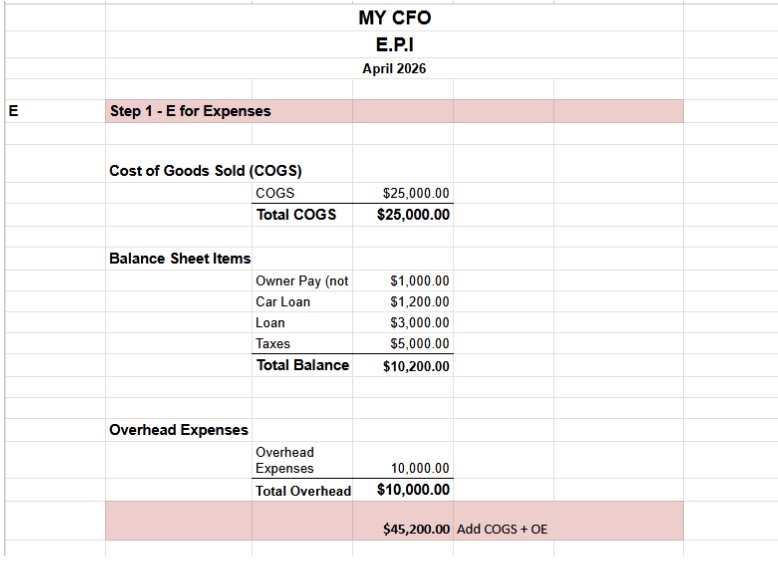
This is the starting point of your business understanding how to become profitable. Inside The STOP Method™, COGS and Expenses are the first KPI because they establish the financial foundation of your business. Every major decision is influenced by these two numbers.
They directly impact:
- How you price your services
- The level of profit you can achieve
- Your overall cash flow
- When and how you hire
- Your ability to grow sustainably
Without a clear understanding of these costs, financial decisions are based on assumptions rather than accurate data. If the “E” is unclear, underestimated, or ignored, the rest of the formula cannot function properly. Profit becomes inconsistent, and income goals are based on guesswork instead of data.
A Mindset Shift When It Comes To Budgeting
Revenue reflects activity within the business, but expenses reflect structure. While revenue often receives the most attention, it is your cost structure that determines whether your business is sustainable. It is crucial that you start with your costs first when you sit down to do your budget. It is the status quo to say you want to do 10% growth in revenue but have no idea what that means for your COGS and Expenses…which might mean you are STILL operating at a loss!
Final Thoughts From Your Favorite Accountant
Understanding your COGS and Expenses first changes your entire mindset on how you operate your business. You begin to build a financial foundation where your pricing, profit, and growth are supported by real numbers.
When you take the time to define the “E” in your EPI Formula, everything else begins to align. Profit becomes intentional. Income goals begin to cover both your costs and your desired margins. Cash flow becomes something that brings peace instead of uncertainty around covering payroll.
If you are ready to get clear on your bookkeeping and build a stronger financial foundation, here is how I can support you:
📊 Bookkeeping Services
💼 Self Guided Financial Masterclasses
📘 Buy my Budgeting Book
Because at the end of the day, cash flow isn’t luck, it’s strategy