
“82% of businesses fail due to cash flow problems,” according to Jessie Hagen of U.S. Bank, cited by SCORE, Counselors to America’s Small Business. The American Psychological Association reports that money is consistently the number one source of stress for adults in the United States.
Now consider that reality through the lens of a business owner.
You are the one people depend on. You are the decision-maker, the visionary, the steady presence when things feel uncertain. You carry payroll, taxes, vendor payments, leadership responsibilities, client expectations, and your family’s security. When financial uncertainty enters that equation, it is so much more than just “stressful”
Chronic financial stress lives in your body. It can show up as exhaustion, irritability, anxiety, headaches, and sleepless nights. You may notice yourself becoming short-tempered or withdrawn. You might feel overwhelmed yet unwilling to admit it because to admit that you need help feels embarrassing and frustrating.
When Uncertainty Fuels Your Anxiety
For many high achievers, it is so hard for us to ask for help. We have a physical reaction to saying the words out loud, even though we are drowning. You are accustomed to being the one who helps others. You pride yourself on solving problems. Admitting that you need support of any kind, especially financially, can feel like a crack in your identity.
There is often a double standard at play. You freely offer guidance, mentorship, and assistance to others, yet hold yourself to a harsher standard. You tell yourself that you should be able to figure it out alone. You rationalize that help is too expensive or that you will invest once revenue grows a little more.
In the meantime, you push harder. You try to outwork the uncertainty. You focus on generating more sales, believing that increased income will settle the anxiety. However, revenue without structure rarely eliminates stress or the negative cash flow and debt that you might be carrying.
Avoidance can feel like protection, but it extends the spiral, causing you to go deeper and deeper into your self sabotage cycle.
The Financial Stories You Inherited
Financial anxiety rarely begins when you start your business. It often traces back to early experiences. If you grew up in a household where money was scarce, tense, or not discussed, those dynamics shape your relationship with financial leadership. Even in homes where income was stable, silence around money can create uncertainty because you don’t feel competent or credible with budgeting.
Over time, these experiences form beliefs. You may have internalized the idea that you are not naturally good with numbers or that financial strategy belongs to someone smarter. You may associate success with strain or believe that stress is simply part of achievement. Behavioral finance research confirms that money beliefs formed in childhood strongly influence adult financial behavior. When those beliefs go unexamined, they shape pricing decisions, spending habits, saving patterns, and whether you seek professional support.
Familiar patterns, even painful ones, can feel safer than change. Growth requires acknowledging that what once helped you survive may now be limiting your leadership and your ability to scale your business in a sustainable way.
The “Just Enough” Cycle in Business
A common expression of these inherited beliefs is operating at what feels like “just enough” or broke-even. I call breaking even, broke even. Because you will always be broke if all you are aiming for is just enough to break even. You generate sufficient revenue to cover expenses and perhaps pay yourself modestly. If you withhold paying yourself consistently, you may frame it as reinvesting back into the business. Because operations are still moving, it becomes easy to postpone paying yourself better or investing in structured bookkeeping or CFO advisory.
Yet operating at “just enough” keeps your nervous system in a constant state of anxiety. You remain focused on the next client, the next sale, or the next deposit. Without defined profit targets, clear margins, and disciplined cash flow systems, decisions tend to be reactive. You may find yourself shifting funds between accounts to maintain balances, delaying vendor payments, or relying heavily on instinct without data to support it.
Intuition is a powerful asset in business. However, intuition without structure creates vulnerability and more anxiety. Financial leadership is not about innate mathematical talent. It is about choosing to get repetition on looking at your numbers and pairing your instincts with disciplined systems. When your financial reports are accurate, your margins are defined, and your cash flow is reviewed consistently, your nervous system steadies, which brings you confidence and hope. You feel empowered with your knowledge versus anxious.
Final Thoughts From Your Favorite Accountant
The stories you tell yourself about money may feel deeply rooted, but they are not permanent. You are not weak for feeling financial pressure, and you are not less capable because numbers feel heavy. High achievers often believe they must outwork every problem. However, financial leadership does not come from trying and failing all by yourself. It comes from education, support, and leaning in to others who can help you.
You are allowed to grow beyond the narratives you inherited. You are allowed to build a business with the help of others.
If you are ready to move from financial anxiety to structured confidence, join me here: Q2 April Workshop
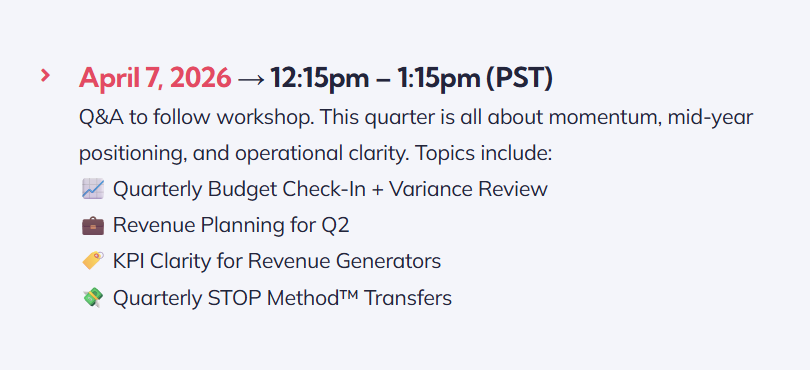
Together, we will strengthen your financial foundation, implement practical systems, and create clarity that supports sustainable growth.
Because at the end of the day, cash flow isn’t luck, it’s strategy.